
The Greens Are Missing
France has cabbage. Always cabbage. But where the hell is the rest of it?

I saw a man on a magazine cover once, holding rainbow chard like he’d just won a pageant — stems fanned out like a vegetable halo. That chard does not exist here. Not in Nantes, not in November, not in the aisles I’ve checked multiple times. What you get instead is the same set of winter regulars: leeks, carrots, cabbage. Turnips. Potato. And they’re also super fresh and wonderful versions of hose things, but that’s also kind of…it.
TLDR:
A long winter of French vegetables ahead, with no kale in sight. Why markets go beige by November, what France does with cabbage, and seven scrap-based recipes for keeping it a bit fresh — including a cheese-laced cabbage “soup” from Aveyron that’s basically a casserole in disguise.
What’s in this piece, in case you want to jump ahead
– My own personal chard grief
– Why France skips kale and Brussels sprouts
– What cuisine de répétition is like
– Smothered turnip recipe & 7 market haul recovery recipes
Missing Greens
Every so often I’ll spot blettes — Swiss chard — slumped in the corner of an organic stand, like an afterthought someone forgot to compost. Not much of it. Not often. My French friends call it a hipster vegetable, probably because it shows up in magazines more than in magasins.
Once, I saw a glossy food mag near the gazingus pin section at the checkout — you know, next to the discount chargers and unnaturally colored snacks for kids — and there it was: a man holding rainbow chard like he’d just won a beauty pageant. Arms cradling a bouquet. Muticolor stems fanned out behind him like celery in neon.
Where the fuck did he find those?
Because what I’ve found here — the thick-stemmed, floppy-armed & very pale stuff — doesn’t sauté the same. The leaves disappear. You’re left with a bowl of stemmy bits, which is fine, kind of nice even, but it’s just not a green.
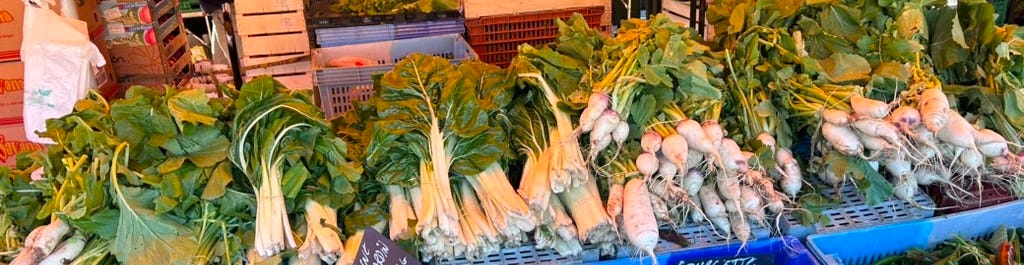
No mess o’ greens
It took a while to notice, but we used to buy and grow a pretty broad range of them. Kale. Collards. Mustard. Turnip greens. Rainbow chard, ruby chard, whatever showed up in the co-op bin that week. The recipe was always basically the same: sauté with garlic and olive oil until wilty. Eat standing over the sink.
Sure, we did other things — soups, beans, kale chips if someone was trying something — but greens were just... there. Always.
Here in France, it’s cabbage. Only cabbage. Always cabbage. The ever-present ball o’ cabbage — round green, round red, and then round-squiggly ( frisée - a personal favorite, but still not a green.)
C’est tout.
Sprouts
“We’re closer to Brussels and I haven’t seen a Brussels sprout in three years,” I told my sister — half-laughing, half-surprised at my own realization.
She thought I was exaggerating. I wasn’t.
Do they have them in Belgium?
“No kale? What the fuck do you mean there’s no kale?” said my friend Will in the Bronx, a guy who’s run a three-acre farm in the borough for twenty years. Practical, furious, deeply tired.
Somehow, he makes turning compost and tending a garden in the Bronx sound like hard-boiled detective work.
The hawks had taken the last of his chickens. Again. He was clearly feeling a bit sensitive about any challenges to his vegetable ideals.
“Cold climate — chard! Kale! You should have all of that. It makes no sense.”
But it does. Sort of.
France isn’t short on vegetables. It’s just not interested in leafy greens outside of salads, it seems. No kale pyramids. No Lacinato. No dinosaur kale. No bundles of mustard greens, callaloo occasionally, thanks to some kind Caribbean folks at the market .
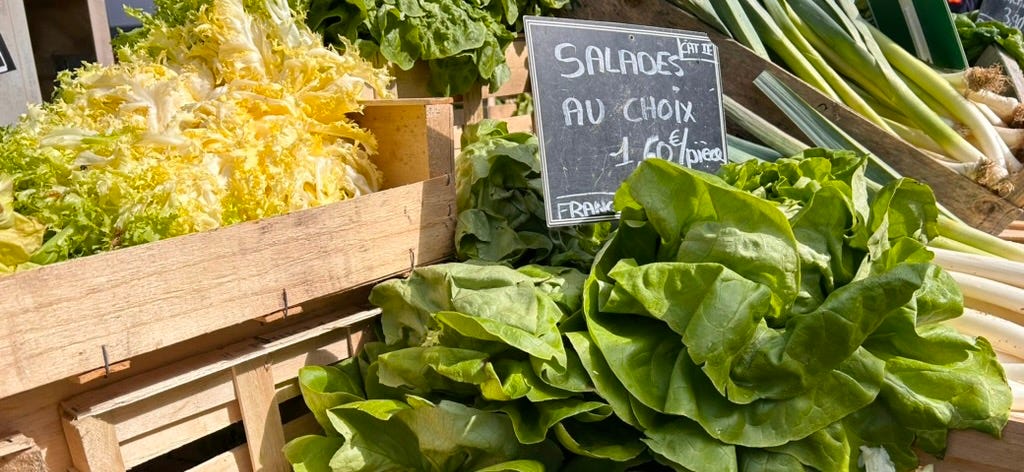
Like corn here, the cooking greens you do see seem to be meant for cows. I’ve passed whole fields of them — huge leaves flapping away — and none of it ever shows up at the market. Just like the rows of feed corn that never end up on a plate.
Back home, we planted Russian kale and collards because they could survive December if you covered them.
I haven’t seen Russian kale either, and that stuff grows anywhere.
They have cabbage. So much cabbage.
Bitter Greens, If You Find Them
If you do get your hands on some radicchio, slice it thin, sauté in butter with garlic and a splash of balsamic, then fold it into potato gnocchi with Parm and a touch of cream. Add prosciutto if you have.
Cheese and black pepper at the end. The bitterness will hold up with flavor no matter how much cheese you hit it with.
When we go to Italy, radicchio is one of the first things I buy.
Same Old Thing The Meters (1969)
A lean, looping groove built from repetition and restraint. The Meters just lock in and let the rhythm do the work. It’s all economy: clipped guitar, dry drums, a lean bassline. This is the sound behind a lot of what came after — funk, hip-hop, New Orleans bounce — but stripped down, letting the tight riff develop nuance. Foundational.
Beige Season
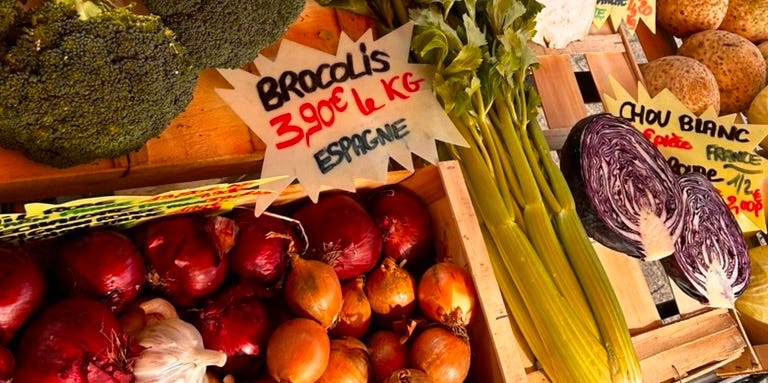
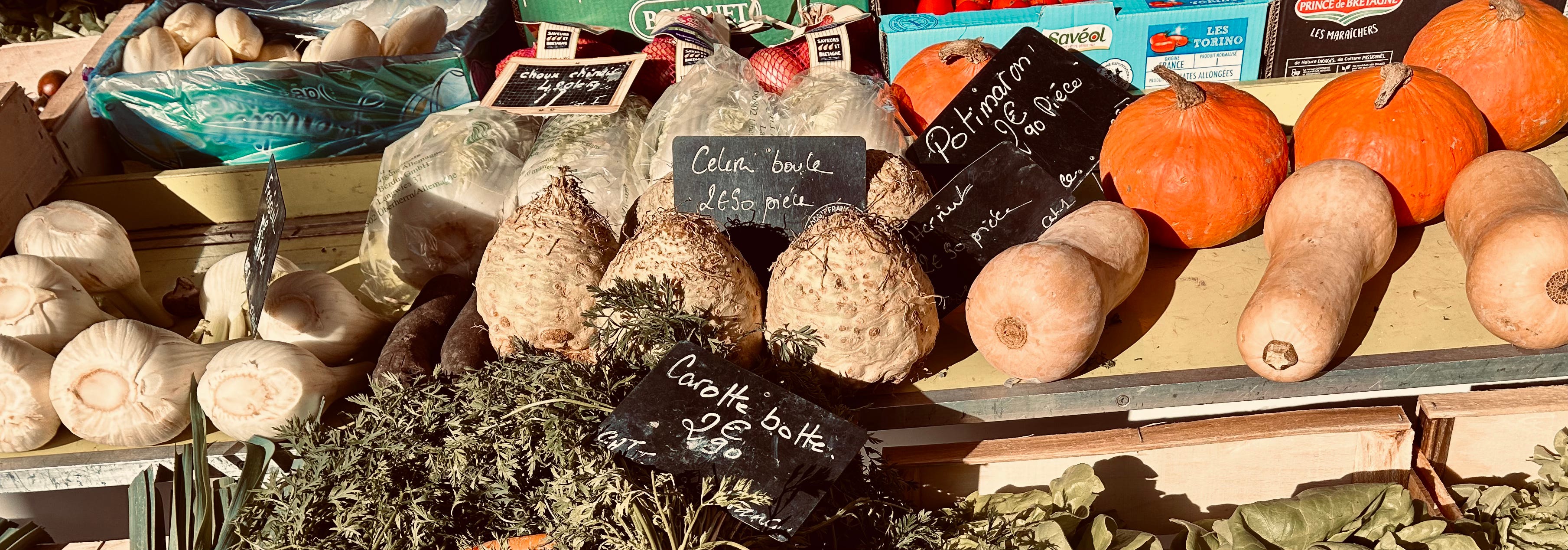
When November rolls in, France goes beige and green. The markets have shrunk a bit. Tomatoes are mostly gone. Eggplants disappear. As winter wears on, you see the same pile of vegetables this week that you saw last week — and the week before that.
Leeks. Carrots. Turnips. Cabbage. Potatoes. Leeks.
I still find myself wandering the aisles trying to locate something that is never there — as if because the walnuts are stacked next to the garlic for some reason, they’ll be in a place I wouldn’t think of.
The same way each supermarket seems to put its eggs in a different aisle.
No rainbow chard. No 15 kinds of squash. No 15 pyramids of various greens like in Berkeley or Brooklyn, three salad heads and arugula.
Just a few earthy basics. Over and over.
Cuisine de Répétition
It’s the same in the supermarkets. One or two “exotic” trays — the kind that clearly don’t turn over often. Sad avocados. A whole coconut. A pineapple with no business being here.
You hear a lot of enthusiasm for cabbage — from recipes, from blogs, from older women in line — which might just be salesmanship. I’ve never seen anyone actually excited about a cabbage.
Still, repetition isn’t laziness. Sometimes, it’s mastery. A few good things, done well, repeatedly.
In the U.S., we sometimes cook like we’re afraid of boredom. We chase variety, fusion, novelty.
French meals are seasonal reruns: leeks with vinaigrette, grated carrot salad, turnips baked until soft and drowned in cheese. The seasonality is part of the charm, even if I want to find frozen blocks of chopped collards.
Still - smothered turnips are lovely. But then again, you could cover just about anything in the right cheese and it’d work out.
Smothered Turnips, à la française
Peel and chop your turnips — squares if you like squares, slices if you like slices. Any kind works, but the small purple-top ones roast best. Toss with olive oil and salt, roast until tender and browned at the edges — the way potatoes get when you forget about them just long enough.
Then smother them: crème fraîche, a grating of nutmeg, and fistfuls of cheese. “Add cheese until cheesy,” a chef friend told me once. That was the whole recipe.
I like throwing in whatever bits are lying around — rinds, crumbles, scraps you meant to use for something else. If you’re shopping with intent: Comté if you’re feeling elegant, Emmental for chewy tang, old mimolette for color and funk. The cheese makes the dish cheap or expensive.
Broil until bubbling and browned at the corners. Until it smells like winter.
Serve with greens — if you can find them.
Cheese & Pork
France, as a culture, throws pork and cheese at a great number of its food problems.
Sometimes to excess.
But it works.
I call it cuisine de répétition — cooking the same five things until they’re deep in your repetroire.
After a while, you start to find variety in the familiar.
Leek, Cabbage, Carrot... and No Chard
Every so often, you’ll see blettes stacked at the edge of a Provençal market, but they’re not what you expect. Pale, stemmy, almost leafless. Mostly ribs, sold individually - because they are huge. The leaves, if they’re there at all, are almost decorative.
My French friends call chard a hipster vegetable, which feels unfair but also a little true. In London, it’s everywhere — rainbow-colored, leafy, sold beside organic kale and oat milk.
In France, blette stayed mostly local, mostly southern from what I’ve seen.
And collards do not exist here. A thick, earthy green simmered for hours doesn’t fit the French palate or rhythm, maybe. There’s no place for it in the canon. France has its leaves — spinach, endive, dandelion, sometimes — but not that deep, meaty green that anchors a Southern or Portuguese pot.
Portugal has couve galega, the long-leafed collard that powers Caldo Verde — a ubiquitous national soup that you could order blind in almost any restaurant. [and Leite’s Culinary is a great site for Portuguese recipes, if you like them - the link]
France has no Caldo Verde, no single national soup built around a green. The closest you get is soupe aux choux or garbure — heartier, porky more than sausage-y, slower. Portugal leans into olive oil and brightness, France uses butter, cabbage, and time.
le remix
French food often re-refines what’s there, rotating through the same quiet set: leeks, carrots, cabbage.
Across France — from Normandy’s buttered leeks, to Brittany’s braised cabbage, to the grated carrots of the west — those three vegetables show up everywhere. I’d guess 40 to 50% of everyday meals include at least one. In winter? Closer to 70 or 80%.
There’s no perfect database, but scan any list of French home classics — pot-au-feu, blanquette, leek vinaigrette, choucroute, garbure — and it’s the same trio. They’re not just ingredients.
They’re infrastructure.
Got a vegetable you miss? A winter recipe you make on repeat? Or a French market mystery you still don’t understand?
Drop it in the comments — especially if it involves cabbage, cheese, or bitterness that works.
Using up the market haul
(Without Going to the Store Again)
Sometimes it’s not even a question of what to cook — it’s what’s left to cook. These are the dishes you make after a week of small markets, vague plans, too many leeks and always at least some part of a cabbage hanging out.
Based on French recipes, adjusted for what’s in the house. Scraps, substitutions, salvage.
1. Leeks Vinaigrette (But With Toasted Breadcrumbs Instead of Herbs)
Steam or boil trimmed leeks until tender. Make a vinaigrette: 1 tsp Dijon, 1 tsp vinegar, 2 tbsp oil, salt, pepper. Pour over warm leeks.
Top with toasted breadcrumbs made from that heel of bread no one wanted. (Pulse in food processor, roll around in a pan with light oil or butter until toasty and aromatic.)
2. Gratin Dauphinois With Strays
Thin-slice potatoes and any root vegetables you’ve got (carrots, turnips, sad parsnips). Layer with salt, pepper, a splash of milk or cream, and whatever cheese scraps you have — rind and all, unless it’s a rind you don’t want to eat.
Bake at 180°C until the top is brown and the edges bubble.
If it looks too dry halfway through, pour a bit more milk around the edges. It forgives.
3. Carottes Râpées With the Bitter Bits
Grate carrots. Toss with lemon juice, Dijon, olive oil, salt.
If you’ve got stray cabbage or chard or even radicchio, slice fine and throw in — they take the mellow the sweetness and make it a bit more complex.
4. Braised Cabbage With Whatever’s Left in the Bottle
Slice cabbage. Sauté onion or garlic in olive oil or butter. Add cabbage, a splash of white wine (or flat cider, or water + vinegar, I’ve used the remains of a can of beer meant for the slugs), salt, thyme. Cover and cook till soft.
Finish with mustard or crème fraîche if you have. If not, more wine.
5. Turnip Mash With Cheese Rinds
Boil turnips and a potato or two until soft. Mash with butter or oil and mix in whatever cheese ends you’ve let languish.
Languishing party cheese, the last chunk of chèvre, that weird wedge you forgot. If it melts, they all work.
6. Vegetable Hash With Garlic
Chop leftover cabbage, carrots, leeks, or whatever’s getting iffy. Scrub them and then put them into ice water for 15 minutes or so if you want to liven them up a little first.
Sauté in olive oil with garlic until browned at the edges. Add paprika or chili.
Top with an egg or grated cheese – or both.
7. Cabbage + Apple Skillet With Mustard Glaze
Slice cabbage and any sad apple. Sauté in butter until softened.
Deglaze with a splash of vinegar and a spoon of mustard stirred in at the end. Add black pepper. A piece of sausage on the side turns it into a meal.
Bonus From Betty: Soupe au Fromage Aveyronnaise
Betty Carlson, who knows her Aveyron from her Auvergne, sent me this one, a soupe that’s not a soup.
Cabbage, old bread, broth, and melted cheese. “I’m seeing some recipes with onion instead of cabbage,” she wrote, “but all the ones I’ve tasted had cabbage.”
Here’s her version.
If you’ve got stale bread, old cheese, and some broth (or bouillon cubes), layer it all in a pot with softened cabbage or onion. Pour hot broth over the top, let the cheese melt through, eat with a spoon. It’s more casserole than soup by the end.
Can you buy kale, chard, and mustard green seeds in France? Vendor recommendation for organic seeds?
I left the US before the kale era, so didn't know what I was missing. It does show up here sometimes in organic supermarkets, and there is one producer at the Rodez market that grows it and all sort of other greens similar to the ones you mention. They run out fast!
I don't deal with blettes very often, although I like them. It seems they were more prevalent in my early years here, but being a complicated vegetable, they have gone out of style. Sometimes I do see manageable-sized ones at Grand Frais, but they don't seem to have many leaves. So you can't really with with them IMO.
Thanks for mentioning La Soupe au Fromage! You are right, it's more a casserole or a gratin. I remember being very surprised the first time I ate it. Have you tried making it yet?